
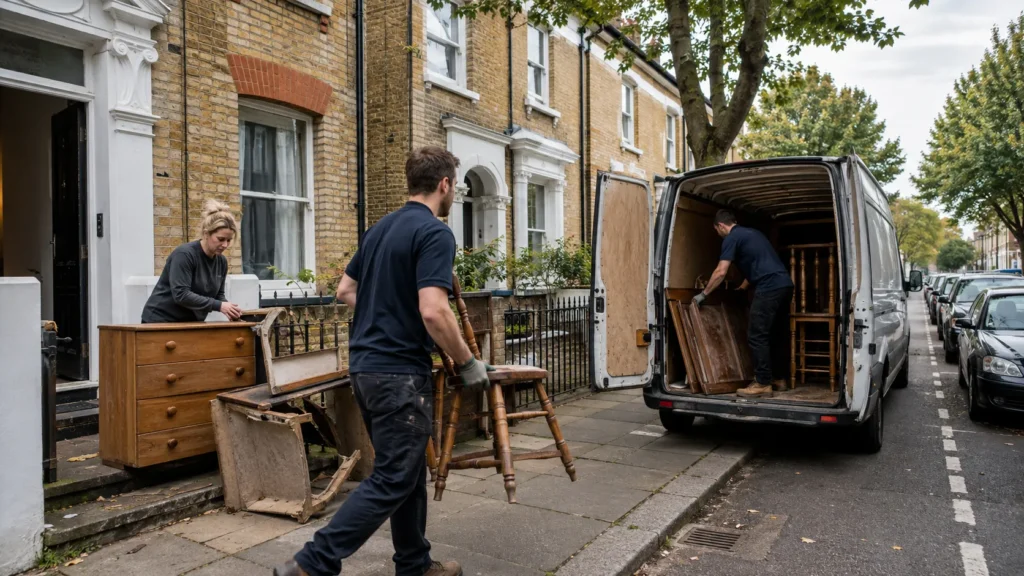
Old furniture can quickly become difficult to manage, particularly when a sofa, wardrobe, bed or dining table is too large to fit into an ordinary household waste collection.
Fortunately, Clapham residents have several responsible options.
Furniture that remains usable may be sold, donated or passed on, while unwanted or damaged items can potentially be collected by the council, taken to an appropriate recycling centre or removed by an authorised private waste collector.
The right choice depends on the condition of the furniture, its size, the property’s access and how quickly it needs to be cleared.
What Is the Most Responsible Way to Get Rid of Old Furniture?
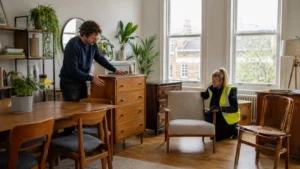
Before treating furniture as waste, consider whether someone else could still use it.
A sensible order is:
- Keep or repair it if practical.
- Sell or give away usable furniture.
- Donate suitable items.
- Use an appropriate reuse or council collection service.
- Arrange responsible waste collection if the furniture cannot be reused.
Reusing furniture can extend its useful life and reduce the amount of material entering the waste system.
However, furniture should only be passed on when it is genuinely suitable for reuse. Broken, badly damaged, contaminated or unsafe items may require disposal instead.
1. Sell or Give Away Furniture That Is Still Usable
Furniture does not necessarily become waste simply because its owner no longer wants it.
A dining table that no longer fits after moving house, an unwanted chest of drawers or a sofa being replaced during redecoration could still have considerable useful life remaining.
Possible options include:
- Selling it through a second-hand marketplace
- Giving it to friends or relatives
- Offering it through a local community group
- Passing it to someone moving into a new home
- Using a local reuse platform
Providing accurate dimensions and clear photographs can make it easier to find someone interested.
For large items, the listing should also make clear whether the new owner is expected to collect the furniture and whether stairs, narrow entrances or restricted parking could affect removal.
2. Donate Furniture to Charity
Donation can be another good option for furniture in suitable condition.
Some charities and reuse organisations accept items such as:
- Sofas
- Armchairs
- Dining tables
- Chairs
- Wardrobes
- Chests of drawers
- Desks
- Bed frames
- Shelving
- Cabinets
Acceptance policies vary considerably.
A charity may refuse an item because of its condition, size, available storage capacity or safety requirements. Upholstered furniture can also be subject to fire-safety requirements.
Residents should therefore contact the organisation before leaving or transporting furniture.
Lambeth Council currently provides a free collection route for certain reusable bulky household items through its partnership with Emmaus, while furniture that cannot be reused or recycled can be handled through the council’s separate chargeable bulky-waste collection service.
3. Book a Council Bulky-Waste Collection
Large furniture is normally considered bulky waste rather than ordinary household rubbish.
Council collection can therefore be an option for items such as sofas, wardrobes, bed frames, mattresses, tables and chairs.
Residents should check which local authority covers their address, as arrangements can differ across the wider Clapham area.
Lambeth Bulky-Waste Collections
Lambeth Council currently accepts furniture as part of its bulky-waste collection service.
As of August 2026, the council lists charges of:
| Number of items | Current listed charge |
| Up to 3 items | £36 |
| Up to 6 items | £70 |
| Up to 10 items | £116 |
These prices can change, so residents should check the current council information before booking.
Items must be included in the booking and presented according to the council’s collection instructions.
Where a property has a front garden, Lambeth asks residents to place items there as close as practical to the pavement boundary. Where there is no front garden, booked items may need to be placed at the front of the property without obstructing the pavement.
Different arrangements apply to residents of Lambeth housing estates, where bulky furniture can be collected from designated areas according to the estate’s collection schedule.
Wandsworth Bulky-Waste Collections
Some addresses around the wider Clapham area may fall within Wandsworth Council’s services.
Wandsworth currently gives households two free bulky-waste collections per year, covering up to four qualifying items per collection. Additional items and further collections can carry charges.
Furniture is among the items the council accepts.
However, the collection service does not normally remove furniture from inside a property. Items need to be made accessible in accordance with the council’s instructions.
For blocks of flats, items generally need to be left at the communal waste collection point or another location specified by the building management. Underground and basement collection restrictions also apply.
This can make council collection less practical for residents who cannot safely move a heavy sofa, wardrobe or bed outside themselves.
4. Take Furniture to an Appropriate Recycling Centre
People with access to a suitable vehicle may be able to transport unwanted furniture to a household waste and recycling centre.
This can work well for smaller pieces such as:
- Bedside cabinets
- Chairs
- Small tables
- Shelving
- Dismantled furniture
- Small cupboards
Larger furniture can be more difficult.
A sofa, wardrobe or bed frame may require a van or other suitable vehicle, and residents should avoid overloading a car or transporting furniture in an unsafe manner.
Residents should also check the recycling centre’s current rules before travelling, including vehicle restrictions, identification requirements and whether advance booking is necessary.
Wandsworth Council, for example, identifies Smugglers Way Household Waste and Recycling Centre as an alternative disposal route for residents with bulky household items.
5. Arrange a Private Furniture Collection
Private collection can be more convenient when furniture is too heavy to move, needs to be removed from inside the property or has to be cleared quickly.
A professional rubbish removal service in Clapham can be particularly useful when unwanted furniture needs to be carried from a house, flat, office, rental property or other premises before being transported for appropriate disposal.
This option can make sense for:
- Sofas and armchairs
- Beds and mattresses
- Wardrobes
- Cabinets
- Tables and chairs
- Desks
- Office furniture
- Shelving
- Dismantled furniture
- Multiple bulky items
It can also be useful when clearing several types of waste at once, such as during a house move, end of tenancy, renovation or complete property clearance.
Anyone using a private collector should make sure the waste is being transferred to someone legally authorised to take it.
Government guidance states that householders have a duty to take reasonable measures to ensure household waste is passed only to an authorised person.
Furniture and mattresses are specifically included within the types of household waste covered by this responsibility.
Can Old Furniture Be Left on the Pavement?
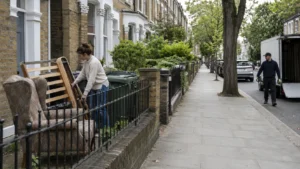
Furniture should not simply be placed outside in the hope that somebody will take it.
Leaving an unwanted sofa, mattress, wardrobe or other furniture on the street without an authorised collection arrangement can create an obstruction and may amount to unlawful waste disposal.
The position is different when an official council collection has been booked and the council specifically instructs the resident to present an item outside.
For example, Lambeth gives residents particular instructions about when bulky items should be placed outside for a booked collection. Wandsworth similarly specifies where and when booked items can be presented.
Residents should therefore follow the collection provider’s instructions rather than putting furniture outside days in advance.
What About Old Sofas and Upholstered Chairs?
Upholstered seating needs particular care.
Environment Agency guidance explains that some waste upholstered domestic seating can contain persistent organic pollutants, commonly known as POPs.
Potentially affected items include:
- Sofas
- Sofa beds
- Armchairs
- Recliner chairs
- Certain dining chairs
- Upholstered stools
- Footstools
- Futons
- Bean bags
- Some upholstered office-style chairs
The rules are relevant because waste seating containing POPs needs specialist waste management and must not simply be sent to landfill.
This does not mean that every usable sofa must automatically be destroyed.
Environment Agency guidance distinguishes between an item genuinely being reused as a product and an item that has already become waste.
Furniture intended for legitimate reuse must meet relevant conditions, including being suitable for its original purpose and not requiring more than minor repair.
For households, the practical approach is straightforward: a genuinely usable item may have a reuse route, while an unwanted damaged sofa being discarded should go through an appropriate authorised collection or treatment system.
Should Furniture Be Dismantled Before Collection?
It depends on the item and the collection service.
Dismantling can make some furniture easier to carry through narrow entrances or down stairs. Examples include:
- Bed frames
- Wardrobes
- Tables
- Shelving units
- Modular cabinets
However, residents should not dismantle furniture if doing so could create sharp edges, unstable components or another safety risk.
Collection providers may also have specific rules.
Wandsworth, for example, requires the mechanism and mattress of a sofa bed to be completely dismantled into separate pieces for its household bulky collection service.
It is therefore sensible to check collection requirements before taking furniture apart.
How Do You Remove Furniture From an Upper-Floor Flat?
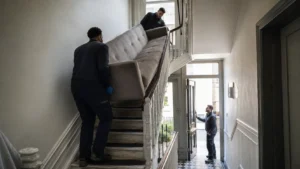
Upper-floor furniture removal can be one of the biggest challenges in Clapham, particularly in converted houses and apartment buildings.
Before moving anything, consider:
- Stair width
- Doorway dimensions
- Lift size
- Communal corridors
- Number of floors
- Furniture weight
- Parking and loading access
- Building-management restrictions
Large furniture should not be forced through a doorway or carried down stairs without enough people to control the load safely.
Where council collection requires an item to be presented outside, the resident generally remains responsible for getting it to the required collection point.
A collection service that includes lifting and loading may therefore be more practical for heavy items located inside the property.
What Is the Best Way to Dispose of Furniture When Moving House?
Moving home is a good opportunity to separate unwanted furniture into different categories rather than treating everything as rubbish.
Keep
Furniture that will be used in the new property should be packed or protected for moving.
Sell or Give Away
Good-quality items that are no longer needed may be offered to another household.
Donate
Furniture suitable for reuse may be accepted by charities or reuse organisations.
Recycle or Dispose
Damaged, unsafe or unusable items should go through an appropriate waste or recycling route.
Sorting furniture early is particularly useful because donation organisations, councils and private collectors may all have different booking times.
Leaving everything until moving day can result in unnecessary disposal of reusable items or difficulty arranging collection at short notice.
How Should Landlords Handle Furniture Left by Tenants?
Landlords and managing agents frequently encounter furniture following a tenancy change.
An outgoing tenant might leave behind:
- Beds
- Mattresses
- Sofas
- Tables
- Chairs
- Wardrobes
- Desks
- Shelving
- Broken furniture
Before disposing of anything, the landlord should establish whether the items have actually been abandoned and consider any legal responsibilities relating to a tenant’s belongings.
Once disposal is appropriate, furniture should be separated into items suitable for reuse and items requiring responsible waste disposal.
Landlords should also check whether council household collection arrangements apply to them. Wandsworth, for example, has separate charging arrangements for residential landlords using its bulky-waste service.
For properties containing numerous items, a complete clearance may be easier than arranging individual collections for each piece of furniture.
How Can Furniture Disposal Be Made More Environmentally Responsible?
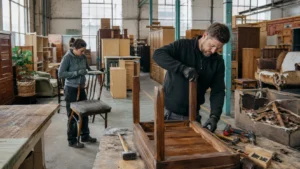
Responsible furniture disposal starts before the item reaches the waste stream.
Residents can reduce waste by:
- Buying durable furniture
- Repairing items where practical
- Reusing furniture in another room
- Selling unwanted pieces
- Donating suitable items
- Choosing legitimate reuse organisations
- Separating reusable furniture from genuine waste
- Using authorised collectors for discarded items
Furniture contains materials such as timber, metals, textiles, plastics, foam and glass. The appropriate treatment route will depend on the construction and condition of each item.
The objective should be to preserve useful furniture where practical while ensuring genuine waste is handled through an authorised route.
Final Thoughts
Disposing of old furniture responsibly in Clapham does not necessarily mean sending it straight to waste.
Furniture that remains usable may be sold, donated or passed to another household. When reuse is not practical, residents can consider council bulky-waste collections, household recycling facilities or an authorised private collection service.
The most important points are to avoid abandoning furniture on the street, check the rules applying to the property’s local authority and make sure discarded furniture is handed to someone legally authorised to take it.
Planning the removal in advance can also make the process considerably easier, particularly for sofas, wardrobes, beds and other heavy furniture located in flats or properties with restricted access.
Frequently Asked Questions
Can Lambeth Council collect old furniture?
Yes. Lambeth currently includes furniture within its bulky-waste collection service. Most residents need to book and pay for the service, although different arrangements apply to Lambeth housing estate residents.
Can Wandsworth Council collect furniture?
Yes. Furniture is included in Wandsworth’s household bulky-waste service. Households currently receive two free collections each year covering up to four qualifying items per collection, subject to the council’s terms.
Can a sofa be donated instead of thrown away?
Potentially. A sofa suitable for genuine reuse may be donated if it meets the receiving organisation’s condition and safety requirements. It is best to confirm acceptance before arranging transport.
Can furniture be collected from inside a flat?
It depends on the provider. Council bulky-waste services may require items to be moved to a specified outside or communal collection point. Private removal services may offer lifting and loading from inside the property.
Can a wardrobe be collected without dismantling it?
This depends on its size, weight, access conditions and the collector’s requirements. Large wardrobes may need dismantling before they can be moved safely through doors or stairways.
Can unwanted furniture simply be left beside communal bins?
Not unless that location has been specifically designated for a booked or authorised bulky-waste collection. Residents should follow their council, landlord or building-management instructions.