
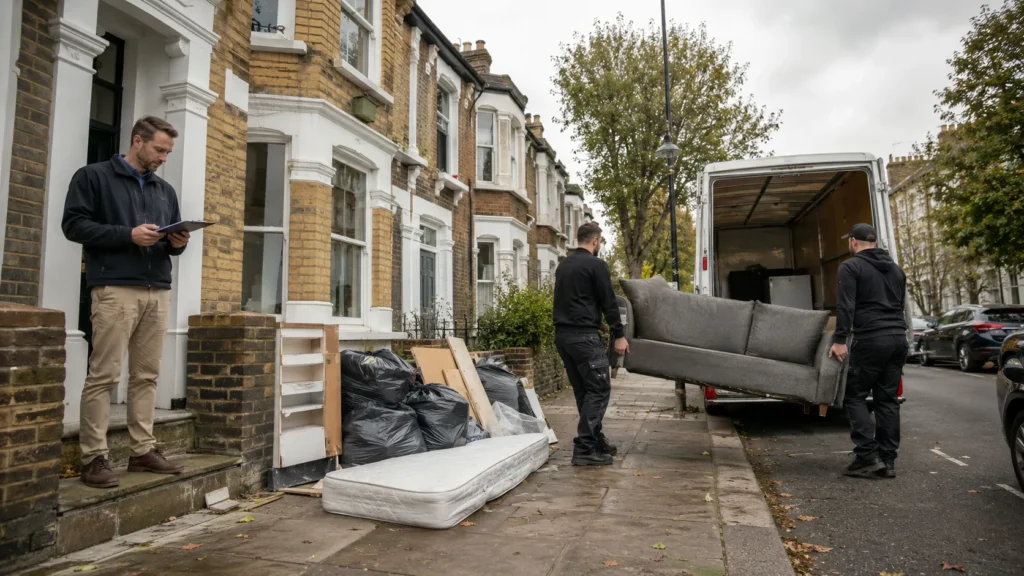
Clearing a rental property in Clapham can involve considerably more than removing a few bin bags.
After a tenancy ends, a landlord may be dealing with abandoned furniture, mattresses, appliances, unwanted household items, damaged fixtures, garden waste or rubbish accumulated during the tenancy.
A larger refurbishment may also produce timber, old kitchen units, flooring, tiles and other renovation materials.
How that waste should be handled depends on what it is, who produced it and whether any belongings still legally belong to a former tenant.
For landlords, that distinction matters. Government waste-duty-of-care guidance specifically states that waste resulting from the clearance of premises after they have been vacated, including a landlord or letting agent clearing accommodation, is not treated as ordinary household waste for duty-of-care purposes.
A properly planned clearance therefore needs to consider the former tenant’s belongings, reuse opportunities, waste classification, collection arrangements and the credentials of whoever removes the rubbish.
When Might a Clapham Landlord Need a Property Clearance?
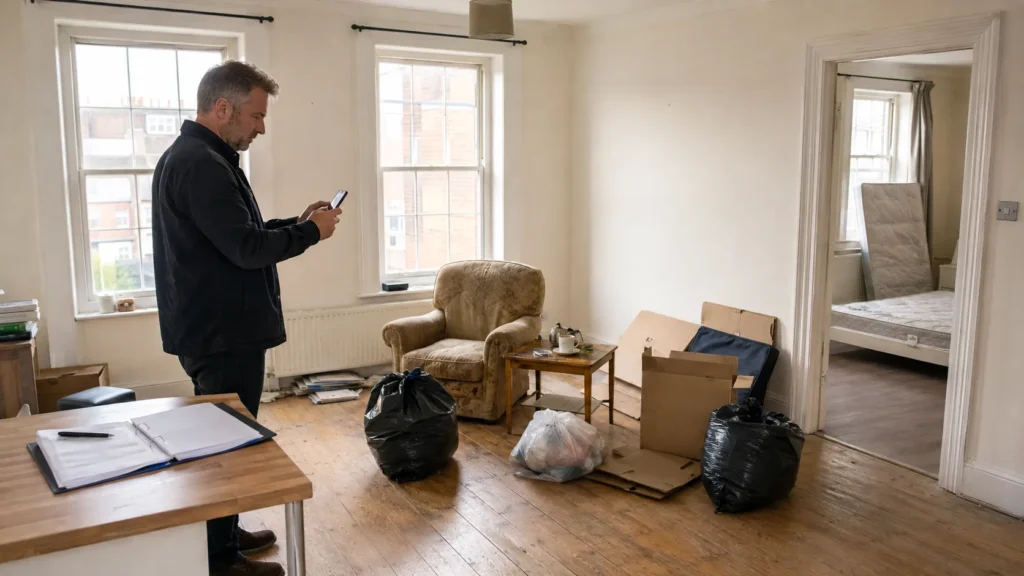
Landlords and letting agents may need a clearance in several situations.
Common examples include:
- A tenant has moved out and left unwanted items
- A property needs preparing for new tenants
- Furniture is being replaced
- An unfurnished property needs clearing
- A tenancy has ended after significant clutter accumulated
- A landlord is refurbishing a flat or house
- Old appliances need replacing
- A property is being prepared for sale
- A garden has become overgrown
- A landlord is converting or upgrading a rental property
The amount of waste can range from a few pieces of furniture to the contents of an entire property.
A small clearance might consist of a mattress, broken chair and several bags. A complete clearance could involve bedrooms, cupboards, kitchen appliances, furniture, garden areas and storage spaces.
What Should a Landlord Do Before Clearing a Property?
Before arranging rubbish removal, a landlord should establish that the tenancy has properly ended and that the items being removed can legally be treated as unwanted.
This is particularly important when personal belongings remain inside the property.
Check That the Tenancy Has Ended
A property should not simply be treated as abandoned because the tenant appears to have stopped living there.
Private renting rules in England changed significantly on 1 May 2026.
Current government guidance explains that landlords seeking possession of an assured periodic tenancy need an appropriate ground for possession and must follow the correct notice and possession procedure.
Where there is uncertainty about whether a tenancy has legally ended, professional housing or legal advice may be appropriate before entering the property and disposing of possessions.
Do Not Automatically Treat Tenant Belongings as Rubbish
A sofa, television, clothes, photographs or other items remaining after somebody leaves do not automatically become waste.
Government guidance relating to possessions left following eviction states that landlords can be responsible for keeping belongings safe for a reasonable period and that a former tenant may potentially claim compensation if their belongings are disposed of without permission.
Landlords should therefore distinguish between obvious rubbish and potentially valuable personal property.
Photograph the Property
Taking dated photographs before a clearance creates a useful record of the property’s condition.
Photographs can document:
- Rooms
- Furniture
- Appliances
- Rubbish
- Existing damage
- Cupboards
- Gardens
- Garages
- Storage areas
This record can also help a clearance company estimate the volume of waste before attending.
Compare the Property With the Inventory
Where a check-in inventory exists, it can help establish which furniture and appliances belong to the landlord and which may have been brought into the property by the tenant.
This is particularly useful in furnished and partly furnished rentals.
What Can Be Removed During a Landlord Clearance?
A typical rental-property clearance can involve several waste categories.
| Waste category | Typical examples |
| General rubbish | Bags, boxes, packaging, unwanted household items |
| Furniture | Sofas, beds, wardrobes, tables, chairs |
| Appliances | Fridges, washing machines, microwaves |
| Electrical items | Televisions, lamps, small appliances |
| Bedroom items | Mattresses, bed frames, drawers |
| Garden waste | Branches, plants, garden furniture |
| Renovation materials | Timber, flooring, tiles, old units |
| Fixtures | Shelving, cupboards, dismantled fittings |
Some materials need separate handling and may not be accepted within an ordinary rubbish collection.
Examples can include asbestos, chemicals, gas cylinders, certain batteries and other hazardous materials.
Landlords should tell the collector about unusual or potentially hazardous waste before a booking is confirmed.
1. Separate Reusable Items From Waste
Not everything left in a property necessarily needs to be disposed of.
Once ownership issues have been resolved, landlords can consider whether suitable furniture or appliances could be reused.
Possible reusable items include:
- Tables
- Chairs
- Wardrobes
- Shelving
- Bed frames
- Desks
- Cabinets
- Working appliances
- Garden furniture
Lambeth Council encourages reuse of suitable bulky items and offers residents a separate collection route for reusable household items through its partnership with Emmaus.
Furniture in poor condition, contaminated items or unsafe electrical equipment may not be suitable for reuse.
Separating reusable material before the clearance can reduce the amount ultimately entering the waste stream.
2. Identify Furniture and Bulky Waste
Furniture is one of the most common components of an end-of-tenancy clearance.
A landlord might need to remove:
- Sofas
- Armchairs
- Mattresses
- Bed frames
- Wardrobes
- Dining tables
- Chairs
- Desks
- Bookshelves
- Cabinets
Whether council collection is appropriate depends partly on the number of items and the local authority involved.
For an entire flat containing furniture, appliances and dozens of bags, a complete property clearance may be more practical than booking separate collections for individual items.
3. Deal With Fridges and Electrical Appliances Separately
Electrical appliances should not simply be mixed indiscriminately with ordinary rubbish.
A rental property may contain:
- Fridge freezers
- Washing machines
- Dishwashers
- Tumble dryers
- Microwaves
- Televisions
- Kettles
- Toasters
- Vacuum cleaners
Large electrical equipment may require a suitable WEEE recycling or treatment route.
Before collection, landlords should also ensure appliances are safely disconnected where practical.
Electrical or plumbing work that requires specialist knowledge should not be attempted simply to prepare an appliance for rubbish collection.
4. Separate Renovation Waste
A property clearance often happens immediately before refurbishment.
This can create a second category of waste.
Examples include:
- Old kitchen cupboards
- Bathroom fittings
- Timber
- Tiles
- Flooring
- Doors
- Plasterboard
- Rubble
- Packaging
- Dismantled shelving
- Removed fixtures
This material should be identified when requesting a quotation because construction and renovation waste can have different weight, disposal and collection requirements.
Who produced the waste also matters.
Government guidance states that where a tradesperson carries out work at a property, the tradesperson is responsible for the waste they produce, including its transport and disposal.
Landlords should therefore clarify waste responsibilities with builders and contractors before work begins.
5. Check Garden and Outside Areas
Landlords should not overlook gardens, sheds, garages and communal spaces during a clearance.
Outside waste might include:
- Branches
- Hedge cuttings
- Broken plant pots
- Garden furniture
- Timber
- Old fencing
- Shed contents
- Storage boxes
- Children’s outdoor equipment
Soil, rubble and very heavy garden materials may need separate assessment because weight can significantly affect collection arrangements and disposal costs.
Can Clapham Landlords Use Council Bulky-Waste Collections?
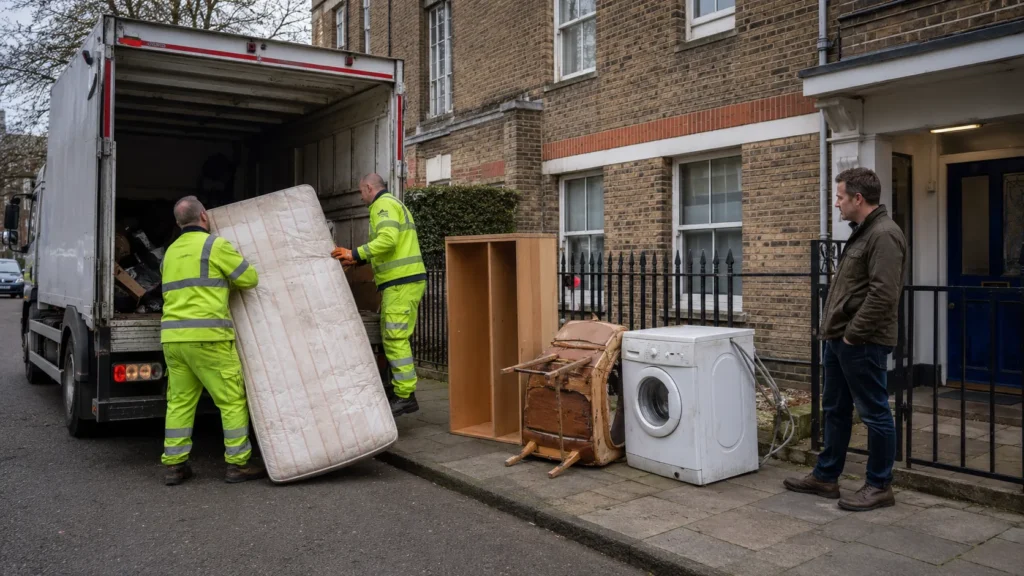
Potentially, but the rules depend on the local authority and type of clearance.
Clapham spans areas where different council arrangements can be relevant, so landlords should check the council responsible for the particular rental address.
Wandsworth Council Collections for Landlords
Wandsworth Council explicitly offers its bulky-waste collection service to residential landlords.
However, landlords do not receive the two free annual collections available to households.
As of August 2026, Wandsworth lists the following residential landlord charges:
| Landlord collection | Current listed charge |
| 1–4 bulky items | £106.70 |
| 5–8 bulky items | £212.70 |
A landlord can currently book a maximum of eight bulky items through this service.
These charges can change, so the current price should always be checked before booking.
The council also has collection restrictions.
Wandsworth states that items cannot be collected from inside the property. Furniture and other bulky waste generally need to be left in an accessible location in accordance with the council’s instructions.
For blocks of flats, this usually means the communal bin storage area or designated waste collection point. Items cannot be collected from underground or basement areas.
This can be an important consideration for landlords clearing upper-floor or basement flats.
What About Landlord Clearances in Lambeth?
Lambeth offers both bulky-waste and larger property-clearance services.
Its standard bulky-waste service accepts items including:
- Furniture
- Mattresses
- Bed frames
- Fridges
- Freezers
- Washing machines
- Televisions
- Other large electrical items
The standard service does not accept certain materials, including hazardous waste, plasterboard, garden waste and rubble.
Lambeth also states that businesses, schools and charities cannot use the normal online bulky-waste booking process and should contact its commercial waste service instead.
Because landlord-generated clearance waste can have different legal status from a resident’s household waste, landlords should confirm which council service applies to their particular clearance rather than assuming the ordinary resident service is appropriate.
For larger jobs, Lambeth Council operates a property-waste-clearance service capable of removing furniture, electrical equipment, builders’ waste and other material from homes or businesses.
Prices currently start from £177.48 including VAT, with a quotation provided according to the job.
When Does Private Landlord Rubbish Removal Make Sense?
Council collections can be useful for a small number of suitable items, but they may not be practical for a full end-of-tenancy clearance.
A professional landlord rubbish clearance service in Clapham may be more appropriate when furniture, appliances, bags and other waste need to be removed together or when lifting from inside the property is required.
Private collection can be particularly useful for:
- Complete flat clearances
- End-of-tenancy waste
- Multiple pieces of furniture
- Heavy appliances
- Upper-floor flats
- Basement properties
- Properties without lifts
- Short turnaround periods
- Pre-sale clearances
- Refurbishment preparation
- Several different waste types
For landlords working between tenancies, being able to clear the property in one organised collection can also simplify cleaning, maintenance and redecorating schedules.
Why Waste Carrier Registration Matters for Landlords?
Landlords should not simply hand waste to the cheapest person offering to take it away.
Government guidance places duty-of-care responsibilities on businesses and others controlling commercial waste.
Waste holders are expected to manage waste safely and ensure it is transferred to properly authorised people.
A landlord or letting agent arranging a clearance should therefore check that the collector is appropriately registered to carry waste.
Government business-waste guidance says organisations should check that their waste carrier is registered and should not allow waste to be disposed of illegally.
This is important because handing rubbish to an unauthorised collector does not automatically remove the waste producer’s responsibilities.
Does a Landlord Need a Waste Transfer Note?
This can be an important difference between a landlord clearance and a normal household rubbish collection.
Government waste-duty-of-care guidance states that waste resulting from a landlord or letting agent clearing vacated accommodation is not considered household waste for these purposes.
Businesses handling commercial waste are generally required to complete appropriate waste-transfer documentation when waste leaves their premises.
Government business-waste guidance specifically includes completing a waste transfer note among the responsibilities for dealing with commercial waste.
Landlords should therefore ensure appropriate waste documentation is obtained and retained when required.
For unusual circumstances or uncertainty about a landlord’s specific legal obligations, advice should be sought from the relevant council, Environment Agency or suitably qualified professional.
How Should a Landlord Prepare for a Clearance?
Good preparation can make a property clearance faster and reduce uncertainty over pricing.
Step 1: Walk Through Every Room
Check:
- Bedrooms
- Living areas
- Kitchen
- Bathroom
- Cupboards
- Loft
- Basement
- Balcony
- Garden
- Shed
- Garage
- Storage areas
Items hidden in cupboards or storage spaces can substantially increase the final waste volume.
Step 2: Decide What Is Staying
Clearly identify any landlord-owned furniture or equipment that will remain in the property.
This prevents useful items from being removed accidentally.
Step 3: Separate Former Tenant Belongings
Items whose ownership is uncertain should be kept separate from confirmed waste until the landlord is satisfied that they can lawfully be removed.
Step 4: Separate Reusable Items
Furniture and working appliances suitable for reuse should be identified before the rubbish clearance begins.
Step 5: Identify Specialist Waste
Tell the collector in advance about:
- Paint
- Chemicals
- Batteries
- Gas cylinders
- Asbestos
- Large quantities of rubble
- Plasterboard
- Very heavy materials
These may need specialist treatment or separate collection.
Step 6: Take Photographs
Clear photographs of every waste pile can help the collection team estimate:
- Volume
- Weight
- Number of bulky items
- Vehicle space required
- Labour requirements
Step 7: Explain Access Conditions
Landlords should disclose whether the property has:
- Stairs
- A lift
- Basement access
- Narrow hallways
- Parking restrictions
- Controlled entrances
- Loading restrictions
- Long carrying distances
This information can affect both the quotation and collection plan.
How Is a Landlord Clearance Usually Priced?
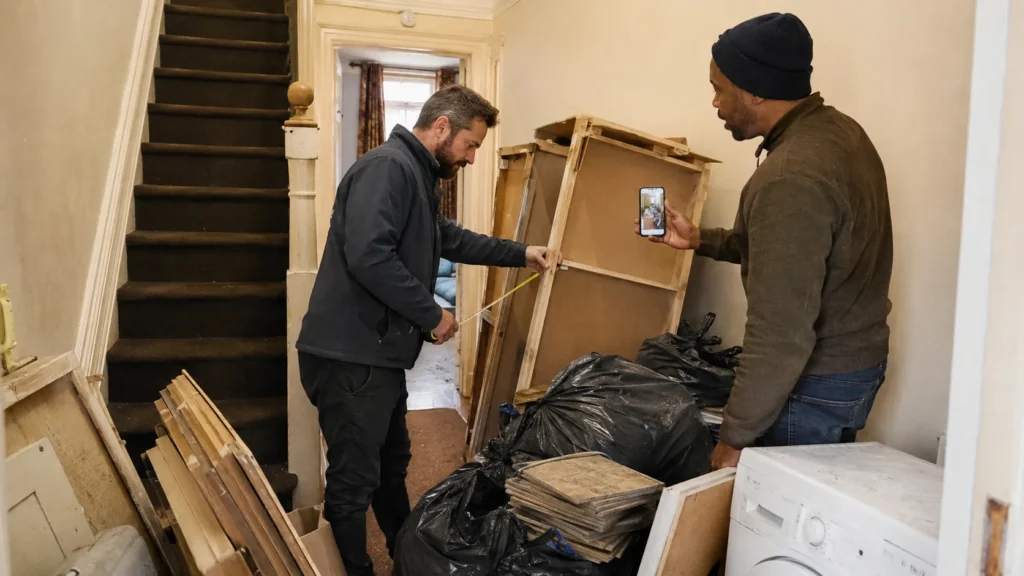
Private property-clearance prices are typically affected by several factors.
Waste Volume
A property containing only several bags and a mattress will generally require less vehicle capacity than a fully furnished two-bedroom flat.
Waste Weight
Dense materials such as rubble, soil and tiles can cost more to handle than lightweight furniture or packaging.
Waste Type
Some materials have different treatment or disposal requirements.
Labour
Removing a sofa from a ground-floor room is different from carrying several wardrobes and appliances down four flights of stairs.
Access
Restricted parking, long carrying distances and limited loading space can increase the time required.
Specialist Disposal
Hazardous or regulated materials may require a separate specialist service.
Providing detailed photographs and access information before collection can therefore produce a more useful initial estimate.
What About Upper-Floor Flats?
Clapham contains many converted houses, mansion blocks, shared properties and flats where access can make clearance more complicated.
Before booking, landlords should consider:
- Floor level
- Lift availability
- Stair width
- Doorway width
- Communal corridors
- Building access codes
- Parking
- Loading restrictions
Heavy furniture should not be carried down stairs by one person when it cannot be controlled safely.
This is also an area where council collection may be less convenient because council teams often require bulky items to be presented at an outside or designated collection point.
Wandsworth specifically states that its bulky-waste crews do not collect items from inside a property and cannot collect from underground or basement areas.
Lambeth similarly states that its standard bulky-waste service does not collect items from inside the property.
What Should Landlords Do With Mattresses?
Mattresses are common after tenancy changes and should be treated as bulky waste rather than placed in ordinary bins.
Possible routes include:
- Council bulky collection
- Retailer take-back when purchasing a replacement
- Private property clearance
- Appropriate recycling or disposal facilities
Landlords should avoid leaving mattresses beside communal bins unless an authorised collection has specifically instructed them to do so.
What Should Landlords Do With Unwanted Appliances?
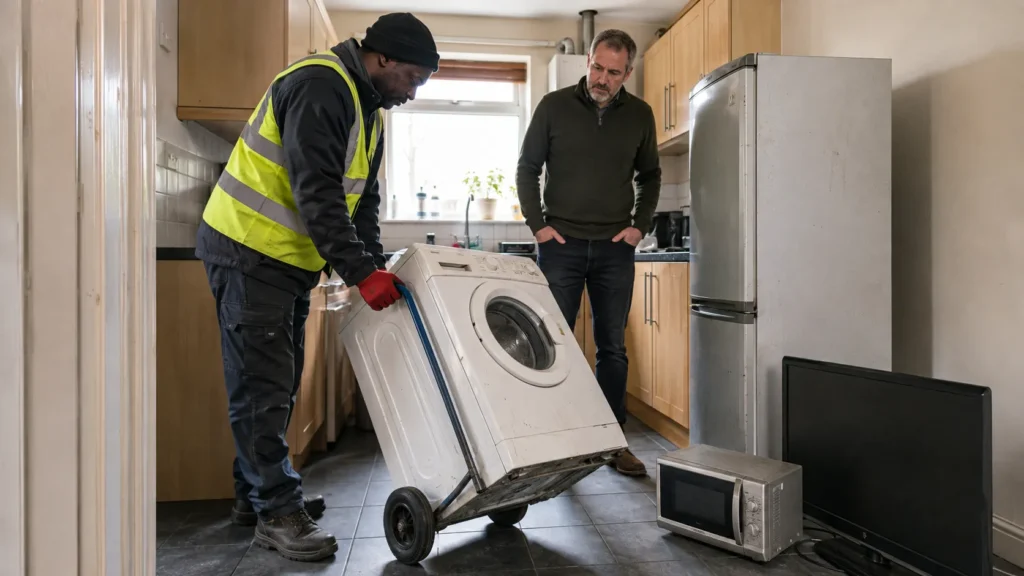
Working appliances may potentially be reused, depending on their condition and safety.
Unwanted or broken appliances should enter an appropriate electrical-waste route.
These might include:
- Fridges
- Freezers
- Washing machines
- Dishwashers
- Tumble dryers
- Microwaves
- Televisions
Fridges and freezers need particular treatment because refrigeration equipment contains components and refrigerants that should be handled through suitable waste facilities.
Where an appliance requires professional electrical, gas or plumbing disconnection, that work should be completed before the clearance rather than asking a general rubbish collection team to undertake specialist disconnection.
What Happens After the Waste Is Collected?
Responsible collection should not end with waste simply disappearing into a van.
Waste should be taken to suitable authorised recycling, transfer, treatment or disposal facilities.
Depending on its condition and type, material may be:
- Reused
- Recycled
- Separated for material recovery
- Treated
- Disposed of through an authorised route
Landlords should keep appropriate records associated with commercial waste movements where required.
How Can Landlords Reduce Clearance Costs Between Tenancies?
Preventing large clearances can be more efficient than repeatedly dealing with accumulated waste.
Practical measures include:
- Maintaining a detailed inventory
- Checking the property’s condition periodically where permitted
- Providing clear waste arrangements to tenants
- Repairing durable furniture where practical
- Removing broken landlord-owned furniture promptly
- Keeping communal storage areas organised
- Planning refurbishment waste separately
- Arranging clearance before cleaners and decorators arrive
It can also help to distinguish between landlord furniture and tenant belongings from the beginning of the tenancy.
Clear records reduce uncertainty when the property is eventually vacated.
Should the Clearance Happen Before or After Cleaning?
In most cases, major rubbish removal should take place before the final deep clean.
A practical turnaround sequence is:
Tenancy ends → inventory/check-out → belongings assessed → rubbish clearance → repairs → cleaning → decoration → final inspection
Removing waste first gives cleaners and tradespeople access to floors, walls, cupboards and other areas that may otherwise be obstructed.
However, legal or ownership questions concerning former tenant belongings should be resolved before those items are treated as waste.
Final Thoughts
Rubbish removal for Clapham landlords requires more planning than simply emptying a property after tenants leave.
The first step is establishing that the tenancy has properly ended and identifying which possessions can legitimately be treated as waste.
Reusable furniture and appliances can then be separated from genuine rubbish, while electrical equipment, renovation materials and specialist waste can be directed to appropriate collection routes.
For small amounts of bulky waste, a council service may be suitable. Larger end-of-tenancy clearances may be easier to manage through a complete property-clearance service, particularly when furniture must be removed from inside flats or when several waste types need collecting together.
Most importantly, landlords should use authorised waste operators, understand when commercial waste duties apply and retain appropriate documentation.
That approach helps keep rental-property turnarounds organised while ensuring unwanted materials are handled through responsible and lawful routes.
Frequently Asked Questions
Can a landlord dispose of everything a tenant leaves behind?
Not automatically. Personal belongings left behind can still belong to the former tenant. Government guidance warns that landlords may be responsible for keeping belongings safe for a reasonable period in relevant circumstances, and wrongful disposal can potentially lead to a claim.
Is landlord clearance waste considered household waste?
Not necessarily. Government duty-of-care guidance specifically says waste resulting from a landlord or letting agent clearing premises after they have been vacated is not considered household waste for this purpose.
Can Wandsworth Council collect bulky waste for landlords?
Yes. Wandsworth currently provides a paid service for residential landlords. As of August 2026, the listed charge is £106.70 for one to four items and £212.70 for five to eight items.
Can council workers remove furniture from inside a flat?
Not usually through the standard bulky services discussed here. Wandsworth and Lambeth both specify that standard bulky items should be presented outside or at an appropriate designated collection point rather than being removed from inside the property.
Can a landlord clear furniture and appliances together?
Potentially, yes. A suitable property-clearance service can often handle multiple categories of non-hazardous waste in a single collection, although electrical, heavy or specialist materials should be identified beforehand.
Who is responsible for builders’ waste?
Government guidance says that when a tradesperson carries out work at a property, the tradesperson is responsible for the waste they produce, including its transport and disposal.
Should landlords check the waste carrier?
Yes. Government business-waste guidance requires businesses handling commercial waste to check that their waste carrier is registered.
Is a waste transfer note required?
Commercial waste is subject to broader duty-of-care requirements, including appropriate waste-transfer documentation. Because waste from a landlord clearing a vacated property is not treated as ordinary household waste under the government guidance, landlords should ensure the correct documentation is used for their circumstances.