
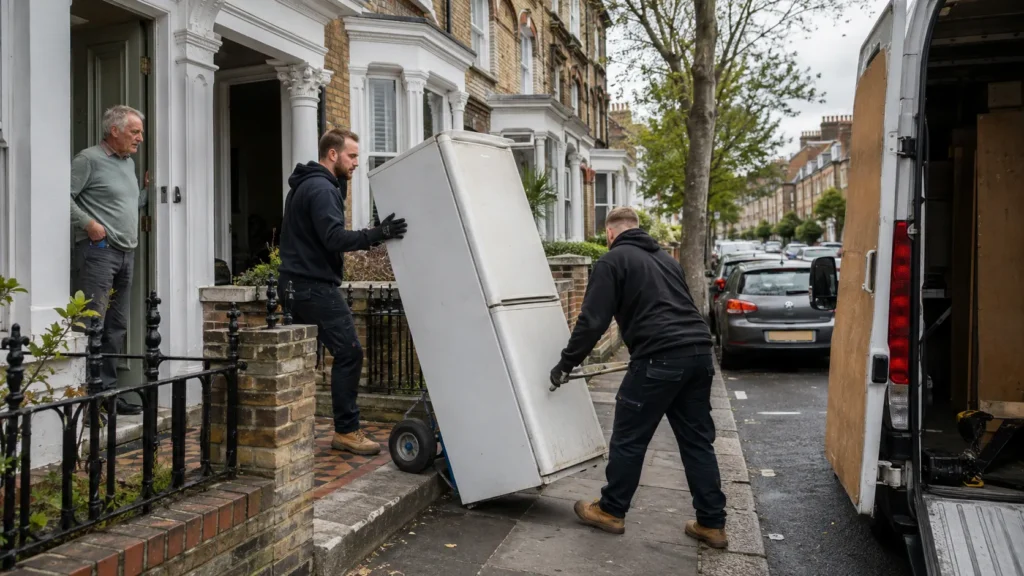
Getting rid of an old fridge or freezer is not as simple as placing it with normal household rubbish. Refrigeration appliances contain electrical components, insulation materials and refrigerants that need to be handled through an appropriate waste or recycling route.
For households in Clapham, the main options include council bulky-waste collections, household recycling centres, retailer take-back schemes, donating a working appliance or arranging collection through a registered private waste carrier.
The best option depends on whether the appliance still works, how quickly it needs to be removed and whether it can easily be moved from the property.
Can You Put an Old Fridge or Freezer in the Bin?
No. A fridge or freezer is far too large for an ordinary household waste bin and should be handled separately from normal rubbish.
Fridges and freezers are classed as waste electrical and electronic equipment when they are discarded.
Government guidance also notes that refrigeration appliances can contain coolants, foam, motors, circuit boards and other components containing potentially hazardous substances. They therefore need appropriate collection, treatment and recycling.
Leaving an unwanted fridge beside household bins without arranging a legitimate collection is not an appropriate disposal method either.
Instead, residents should choose an authorised route that ensures the appliance is transported to a suitable recycling, treatment or waste facility.
What Are the Main Ways to Dispose of a Fridge in Clapham?
Clapham households generally have several options.
| Disposal option | Best suited to |
| Donate or give away | Working appliances in reasonable condition |
| Retailer take-back | People buying a replacement fridge or freezer |
| Council bulky collection | Residents able to meet council collection requirements |
| Recycling centre | Residents able to transport the appliance themselves |
| Private rubbish collection | Fast removal or properties where moving the appliance is difficult |
Before choosing a disposal method, it is worth checking whether the fridge still works.
1. Donate or Reuse a Working Fridge
If the appliance is still safe and functional, reuse should normally be considered before disposal.
A working fridge or freezer might be:
- Given to a friend or family member
- Offered through a local reuse network
- Sold second-hand
- Donated to an organisation that accepts electrical appliances
- Passed to a household that can make further use of it
Wandsworth Council, for example, recommends considering donation or reuse for fridges and freezers that remain in good condition.
Reusing a functioning appliance extends its useful life and avoids treating something as waste before necessary.
Anyone donating an appliance should be clear about its condition. A fridge with serious electrical faults, damaged wiring or a leaking cooling system should not simply be passed to another household.
2. Ask the Retailer to Take the Old Appliance
People replacing an old fridge or freezer may be able to arrange collection through the retailer supplying the new appliance.
Government household-waste guidance identifies retailer take-back as one option for old electrical equipment when a customer purchases a new product serving the same function.
Some retailers collect the old fridge at the same time as delivering the replacement. Others may charge a collection or recycling fee.
It is worth checking this before completing an order because having the old appliance removed during delivery can avoid the need to organise a separate collection.
Customers should confirm whether the retailer requires the appliance to be:
- Empty
- Defrosted
- Disconnected
- Accessible from the entrance
- Ready before the delivery team arrives
Requirements differ between retailers.
3. Use a Council Bulky-Waste Collection
Council bulky-item collections are another option, but the exact service depends on the property’s local authority.
This is particularly important around Clapham because residents should check which council manages waste services at their address rather than assuming the same rules apply throughout the wider area.
Lambeth Council Fridge and Freezer Collection
Lambeth Council currently includes fridges, freezers and other large electrical items within its bulky-waste collection service.
As of August 2026, Lambeth lists charges of £36 for up to three items, £70 for up to six items and £116 for up to ten items. These prices can change, so residents should confirm the current charge before booking.
There are also preparation requirements.
Lambeth instructs residents to seal fridge and freezer doors shut before collection and to present bulky items outside within the council’s specified collection window. Items must also be included in the booking.
A practical drawback for some Clapham residents is that council collection is generally not an inside-property removal service. Someone may therefore need to move the appliance into the required collection position beforehand.
That can be difficult when dealing with a heavy fridge in an upstairs flat, basement property or building with narrow stairs.
Wandsworth Council Fridge and Freezer Collection
For properties covered by Wandsworth Council, the arrangements are different.
Wandsworth currently offers households two free bulky-waste collections each year, with up to four qualifying items included in each free collection. Additional collections and extra items can carry charges.
The council lists standard freestanding fridges and freezers among the white goods it can collect.
However, there are restrictions. Wandsworth states that commercial, American-style and side-by-side fridge freezers are not accepted through its standard household bulky collection. Fridges and freezers must also be emptied of food.
Wandsworth’s collection crews generally require items to be placed outside and accessible at street level rather than being removed from inside the property.
These differences make it important to check the current rules applying to the property’s postcode before arranging council collection.
4. Take the Fridge to a Household Recycling Centre
Residents who have suitable transport may be able to take an unwanted fridge or freezer to an authorised household waste and recycling centre.
For example, Wandsworth Council directs residents to the dedicated fridge and freezer area at the Smugglers Way Household Waste and Recycling Centre.
The site is intended for residents rather than commercial waste disposal, and motorists need to follow its current access and booking requirements.
Lambeth Council’s waste guidance also directs residents with fridges and freezers towards approved recycling or bulky-waste routes.
Taking a fridge to a recycling centre can be economical, but transportation is often the difficult part.
A fridge is heavy, awkward to manoeuvre and may not fit safely inside an ordinary car. Residents should avoid damaging refrigerant pipes or electrical components while trying to move the appliance.
If safe transportation cannot be arranged, collection is usually the more practical option.
5. Arrange Private Fridge or Freezer Collection
Private collection can be useful when an appliance needs to be removed quickly or when the resident cannot move it outside for a council collection.
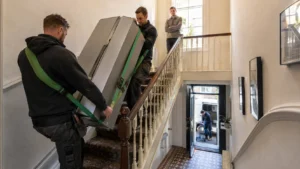
For example, a professional rubbish removal service in Clapham can be suitable for properties where a fridge needs to be lifted from inside a house or flat and transported for appropriate disposal.
Private collection can be particularly useful for:
- Upper-floor flats
- Basement properties
- Buildings without lifts
- Narrow hallways or staircases
- Rental property clearances
- End-of-tenancy clearances
- Multiple appliance collections
- House clearances
- Urgent collections
- Properties where residents cannot lift the appliance themselves
The important point is to use an authorised waste operator.
Householders have a legal duty to take reasonable measures to ensure their household waste is transferred to an authorised person.
Government guidance recommends checking that a private waste business has a valid upper-tier waste carrier registration before handing waste over.
This helps reduce the risk of appliances being illegally dumped or handled through an unsuitable waste route.
How Should a Fridge Be Prepared for Collection?
Preparing the appliance beforehand can make collection easier and safer.
Empty the Fridge
Remove all food, bottles, containers and freezer contents.
Food should be dealt with separately rather than left inside the appliance. Some council services specifically require fridges and freezers to be empty before collection.
Switch It Off
The fridge should normally be switched off and disconnected from the electricity supply before removal, provided it is safe to do so.
If the appliance is hard-wired, connected unusually or requires specialist disconnection, professional advice may be needed rather than attempting the work without suitable knowledge.
Defrost the Freezer
A freezer should ideally be allowed to defrost before collection.
Water from melting ice should be removed so that it does not leak across floors, communal hallways or stairs while the appliance is being carried.
Remove Loose Items
Shelves, drawers and other loose internal components can move when the fridge is tilted.
They can either be secured or removed and packed separately to reduce the risk of damage or injury.
Keep the Doors Secure
If an appliance will be left outside awaiting an authorised collection, the doors should be secured appropriately.
Lambeth Council specifically tells residents using its bulky-waste service to seal fridge and freezer doors shut so children cannot get inside.
Can a Fridge Be Left on the Pavement?
An unwanted fridge should not simply be placed on the pavement in the hope that somebody collects it.
Where a council collection has been booked, the council may give specific instructions about when and where the appliance should be presented.
For example, Lambeth has defined presentation times for booked bulky-waste collections, while Wandsworth also sets conditions for items placed outside ahead of an arranged collection.
Those arrangements are different from abandoning an appliance without a collection booking.
Residents should therefore keep the fridge on their property until the permitted presentation time wherever possible and follow the instructions provided by the collection service.
What Happens to an Old Fridge After Collection?
A responsibly collected fridge should enter an appropriate waste-treatment or recycling process.
Unlike ordinary household rubbish, refrigeration equipment needs specialist handling because different parts of the appliance may require separate treatment.
Materials that may be recovered include:
- Metals
- Certain plastics
- Electrical components
- Other recyclable materials
Refrigerants and insulation materials must also be handled appropriately.
Government waste-classification guidance highlights that refrigeration equipment can contain potentially hazardous coolants, foam and other components, which is why correct treatment matters.
Council Collection or Private Fridge Removal: Which Is Better?
There is no single best option for every household.
Council collection can be suitable when the resident is happy to work around the available collection schedule and can move the appliance to the required collection point.
A recycling centre may work well when the resident has suitable transport and can safely load and unload the fridge.
Retailer take-back is convenient when a replacement appliance is already being purchased.
Private collection can be more practical when speed, lifting, stairs, difficult access or removal from inside the property are important.
The decision should therefore be based on cost, convenience, access and how quickly the appliance needs to be removed.
How Can Landlords Dispose of Fridges Left by Tenants?
Fridges and freezers are frequently left behind during tenancy changes, particularly in furnished or partly furnished properties.
Before disposing of an appliance, a landlord or managing agent should first establish who owns it and whether it has actually been abandoned.
Once disposal is appropriate, the appliance should be kept separate from ordinary rubbish and passed through a legitimate waste route.
For a property containing several unwanted items, arranging a combined clearance may be more efficient than organising separate collections for a fridge, furniture, mattresses and general household rubbish.
Landlords should also remember that council rules and charges may differ from those applying to ordinary household residents. Wandsworth Council, for example, has separate charges and conditions for residential landlord bulky-waste collections.
Final Thoughts
There are several responsible ways to dispose of a fridge or freezer in Clapham.
A working appliance may be suitable for reuse or donation. Someone buying a replacement may be able to use retailer take-back.
Council bulky-waste services and household recycling centres provide additional options, while registered private waste collectors can help when faster collection or lifting from inside a property is required.
Whichever method is chosen, the fridge should not simply be abandoned beside bins or on the street.
Using an authorised collection or recycling route helps ensure that refrigerants, electrical components and recyclable materials are handled properly while keeping the property and surrounding streets clear.
Frequently Asked Questions
Can an old fridge go in a normal rubbish collection?
No. A fridge or freezer should be dealt with through an appropriate electrical-waste, recycling or bulky-waste service rather than an ordinary household rubbish collection.
Does Lambeth Council collect fridges?
Yes. Lambeth Council currently lists fridges and freezers among the white goods and large electrical items accepted through its bulky-waste collection service.
Does Wandsworth Council collect fridges?
Yes, standard household fridges and freezers can currently be included in Wandsworth’s bulky-waste service, subject to its collection conditions. The council excludes certain commercial, American-style and side-by-side models from the standard service.
Should a fridge be emptied before collection?
Yes. Food and other contents should be removed before the appliance is collected. This makes handling safer and is specifically required by some council collection services.
Can someone collect a fridge from inside a flat?
It depends on the service. Council collections generally require items to be placed at a designated outside or street-level collection point. A private clearance service may be more suitable when lifting and removal from inside the property are required.
Can a working fridge be donated?
Potentially, yes. If the appliance is safe, clean and in reasonable working order, reuse or donation may be preferable to disposal. Acceptance rules vary between charities and reuse organisations, so they should be checked before transport is arranged.